The critters know it’s time. They feel the huge after-winter, hooray-it’s-springtime yawns that emanate from the caves. The mountain crisp air basks in the brilliant sunshine. The last of the snow has melted into the soggy ground where baby grasses peek above the dirt. The critters hear a hungry growl. They all look for back-row seats in trembling anticipation.
Gurranny stumbles into the clearing in front of the caves. This is a tradition for her. She is the last of a line of coyote. She can see the other out-of-line coyotes lurking in the shadows hoping the sun will hurry up and set so they can return to the comfort of the more tender moon. They would not dare the sunshine. Nor would they ever consider ‘running with the bears.’
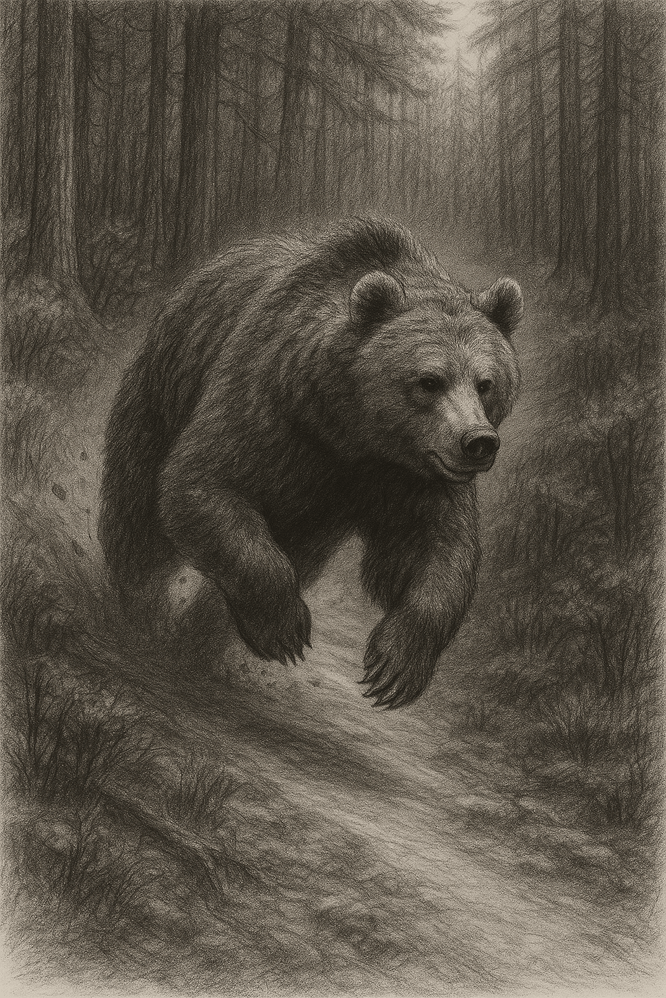
Gurranny ran with the bears long before her fearful kin were coyotitos. She had run with grizzlies, blacks, and browns. Last year had been the wildest. Since the endangered species act had taken effect, the population of famished bears, rising in unison and racing out of their caves, through the clearing, down the path, and into the quiet mountain lake full of thirst-quenching water and delectable rainbow trout, had grown considerably.
Gurranny, surprised by the giant hordes of bears racing pell-mell toward her, tripped on a rock. Her wooden crutch flew from her sweaty paws. It flipped over twice and was positioned in such a way that when the lead bear, looking only at the trout doing a fly-catching leap above the lake, was at the point where his next step would have been a claw to Gurranny’s face, he met the end of the stick exactly where his belly button hid beneath a mat of bear hair. The other end of the branch buried in the ground.
If Sir Isaac Newton had analyzed the physics of the meeting of crutch and bear, he would have confirmed the theory that the angle of the momentum times the weight of the moving object divided by the tensile strength of a dried-up pinon branch is equal to a flipped over bear, a broken stick, and an unscathed Gurranny.
This year will be different she promises herself. She remembers the thrill of jumping over plummeting bears, dodging snarling teeth and dagger claws. In her youth, she called it ‘dancing with bears.’ As she nipped their heels, they would whirl around in pirouetting rage. She played with the bears in those days; bears thinking of nothing but their empty stomachs; bears with the blood of their brains high-tailing it to the promise of greener pastures in the stomach below; bears so dumb you could play with them.
Gurranny’s youth left her many years ago for parts unknown. She knows that this could be her last year ‘running with the bears,’ but she knows in her heart that this will be her gurrandest, gurreatest, and gurrooviest performance.
She hears movement in the caves above. Little growls sneak out and tickle the ears of the spectators hidden in the forest. Gurranny wonders if they are stomach growls or the kind that filters though sharp teeth. Either way, now there are many more of them, and they are no longer little. The growls enlarge to snarls coupled with loud gurrs. Then the growls take the lead, and Gurranny knows that the pep talks are nearly over. It is time for the main event.
The tension mounts like an apocalyptic equestrian. A blue jay squawks, a ready signal if Gurranny ever heard one. The bears emerge from their winter darkness blinking and squinting into the bright yellow sunshine. Their noses twitch. A chorus of grumbles echo from empty stomachs.
Another blue jay squawks, and they are set. The bear eyes are focused and intent upon the lake below.
A hefty old blackbird, turned a peppery grey from years of working the road-kill circuit on Road T, lands on Gurranny’s back just as he has done every year of the old coyote’s ‘running with the bears.’ He opens his crooked beak and lets loose a cracked, crackled, and weathered screech which the spectators, Gurranny, and the bears can only interpret as “Go!”
Before the signal scatters to the four winds, the bears are off, oblivious to all but their stomachs and the trout-laden lake below. The ground rumbles as they stampede down the hill. The ants scurry for cover as their earth quakes.
Gurranny’s eyes are open wide. Through her cataracted corneas, all she sees is a tidal wave of brown. Her nose smells bear breath and sweat. Her mind sends panic signals to her legs but end up on the slow train to Georgia. Her unalerted legs freeze with age and arthritis.
For a moment, , , , , time stands still, rooting for Gurranny to run, jump, move, or at least duck.
In that brief instant when time takes a coffee break, Gurranny is able (albeit with the aid of her new 3-legged pinon crutch) to rise to her back legs. Trying to keep her balance, she spreads her front legs out just as time punches the clock again and the lead bear, looking only at the lake beyond, plows into her, belly to chest.
Gurranny is knocked off her feet but holds on to the matted bear fur with her scraggly claws. Losing little speed, the bear shakes and returns to the four-legged race as Gurranny struggles to Ursa’s back.
In another flash of time, Gurranny is riding, jockey style, astride the huge bear, and they are heading toward the finish line.
Gurranny looks up at the sun and howls a tribute to the bears, the sun, and to life itself.
Oops! The lake! Gurranny goes head first into the lake. Into the crystal mountain spring water, she splashes like a never-bathed, crippled old coyote would dive with arms and legs spread crookedly wide and unswan-like. Her mouth is wide open as she enters the water and something catches between her remaining seven teeth. She struggles to the top and dog paddles (God forbid) to the shore.
She crawls onto the bank, 14-inch rainbow trout in her mouth. The spectators go wild. The blue jays squawk. The chipmunks chatter. The blackbird sings like an oriole. The rabbits thump their back feet. And, all her coyote kin howl in the bright sunshine for the first time in their lives.
 Coyotes, Gods, and Other Critters